
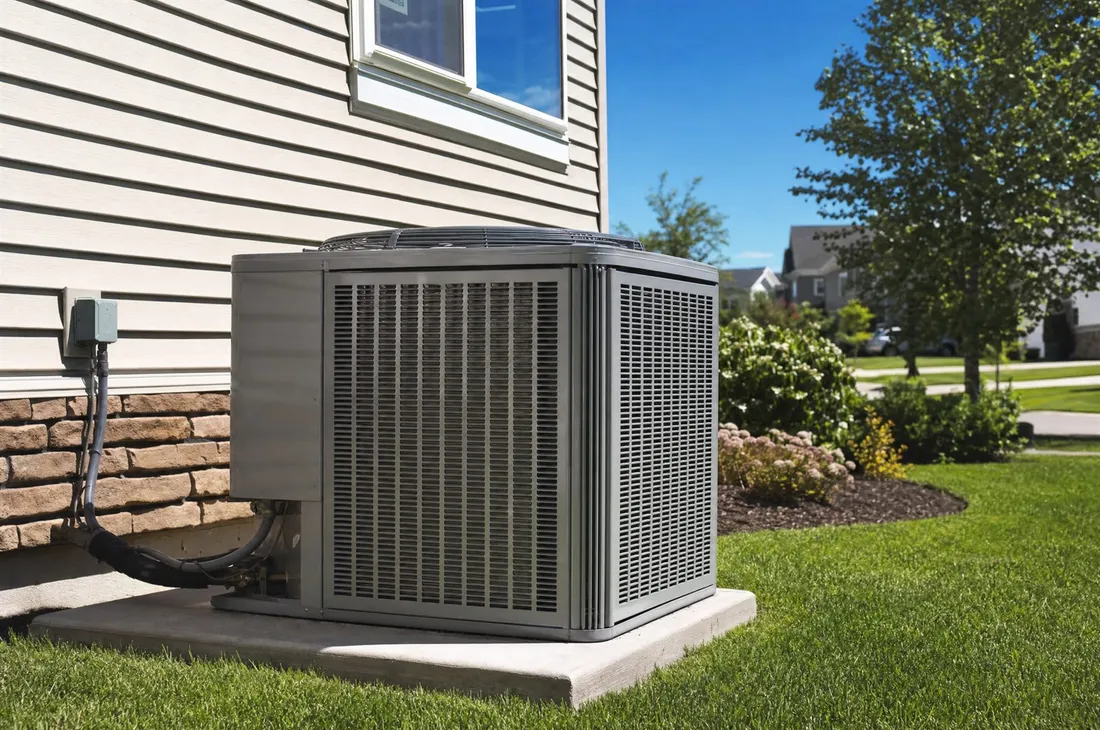
An AC that runs but won't cool usually has a thermostat, filter, or airflow problem. Less often, the cause is refrigerant, ducts, or a dying compressor.
A Twin Cities summer is short. It never feels short when the AC quits. The metro averages 13 days at 90 degrees or hotter each year, and July dew points often sit in the sticky 70s. When the system hums along but the house stays warm, one of eight problems is almost always to blame.
This guide ranks those eight causes from most common to least. The order follows what Carrier lists as the usual suspects, plus parts-failure data from a national HVAC supplier. Each entry shows what the fix costs and whether you can do it yourself. The first three cost little or nothing to rule out. If you're typing "why is my AC not cooling" into a search bar right now, start there.
Cost ranges come from Angi, HomeAdvisor, and This Old House repair data. Local quotes vary.
The 8 Causes at a Glance
| Rank | Cause | Fix It Yourself? | Typical Repair Cost |
| 1 | Thermostat settings or failure | Often | $0, or $114 to $264 to replace |
| 2 | Dirty air filter | Yes | $10 to $30 for a filter |
| 3 | Blocked outdoor unit | Usually | $0, or $75 to $200 for pro cleaning |
| 4 | Tripped breaker or dead capacitor | Breaker only | $200 to $400 for a capacitor |
| 5 | Low refrigerant from a leak | No | $250 to $1,600 |
| 6 | Frozen evaporator coil | Sometimes | $0 to thaw, more if damaged |
| 7 | Leaky or blocked ducts | No | $500 to $4,000 to seal |
| 8 | Failing compressor | No | $800 to $2,300 |
1. Thermostat Settings or a Failing Thermostat
Carrier lists the thermostat first among common causes: a fan switch set to "on" instead of "auto," dead batteries, or a failed sensor. Start here because it's free. With the fan set to "on," the blower runs nonstop, even between cooling cycles. So warm air pours from the vents part of the time. Set the fan to "auto" and the mode to "cool." Then set the target five degrees below room temperature and give the system a few minutes. Still warm? Swap the thermostat batteries. If the screen is dead or the readings drift, the unit itself may have failed. HomeAdvisor puts a typical replacement at $114 to $264 installed.2. A Dirty Air Filter
A clogged filter chokes airflow, so the system runs long but moves little cool air. It is the cheapest fix on this whole list. The numbers back this up. Energy.gov reports that swapping a dirty, clogged filter for a clean one can cut an air conditioner's energy use by 5% to 15%. The same agency says to change or clean the filter every month or two during cooling season. Do it more often with pets or dust. There's a second reason to act fast. A starved system can ice up its indoor coil, which is cause number 6 below. A $15 filter beats that repair every time. Hold the filter up to a light. If you can't see light through it, replace it.3. A Blocked or Dirty Outdoor Unit
The outdoor coil dumps your home's heat outside. Coat it with cottonwood fluff, grass clippings, or dirt, and the heat has nowhere to go. This one is a true Minnesota problem. Cottonwood seeds fly every June, and local HVAC crews spend the month rinsing matted fluff off condenser coils. A coated coil traps pressure, and the system can't shed heat, so it may even shut itself down. The fix is usually free. Cut power at the outdoor disconnect. Then rinse the coil fins with a garden hose at a steep angle, top down. Never use a pressure washer, which flattens the fins. Energy.gov also advises keeping plants trimmed at least two feet back from the unit. If the coil stays grimy inside, Angi puts pro condenser coil cleaning at $75 to $200.4. A Tripped Breaker or a Dead Capacitor
Electrical parts fail more than any other part of an AC. One national supplier's 2025 to 2026 order data shows run capacitors alone made up 31% of AC repair part orders. Check the breaker panel first. If the AC breaker has tripped, reset it once. If it trips again, stop and call a technician, because a repeat trip means a real fault. The capacitor is the usual culprit behind a silent or humming outdoor unit. It gives the fan and compressor motors their starting jolt. July heat kills capacitors in droves. That same supplier's data shows July capacitor orders spiking to more than triple the January baseline. The telltale sign: the outdoor unit hums, but the fan won't spin. Angi puts replacement at $200 to $400. Leave this one to a pro. Capacitors hold a charge even with the power off.5. Low Refrigerant From a Leak
An AC never uses up refrigerant. If the level is low, the system is leaking, and the cooling fades until someone finds and fixes the leak. Watch for warm air from the vents, ice on the copper lines, or a faint hiss near the unit. This repair is not a DIY job. Federal law under EPA Section 608 limits refrigerant work to certified technicians. Angi puts leak repair at $250 to $1,600, with an average around $800. A recharge alone runs $150 to $500, but paying for refrigerant without fixing the leak means paying again next summer. Age matters here too. Older units running R-22, which the US stopped making in 2020, can cost $100 to $350 per pound to refill. The newest systems use R-454B, which saw a supply shortage and a price jump of more than 40% in 2025. Mid-era R-410A units stay the cheapest to recharge for now.6. A Frozen Evaporator Coil
Ice on the indoor coil blocks cooling almost entirely. The ice is a symptom. The real cause is weak airflow or low refrigerant. It sounds backwards, but a frozen coil makes a house hot. Ice seals off the coil, so the blower pushes air past it without cooling. Some units drip or blow visible frost from the lines. Shut off cooling, switch the fan to "on," and give the ice a few hours to melt. Check the filter while you wait, since a clogged filter is the most common trigger. If the coil freezes again after a clean filter and a full thaw, call for service. Running a frozen system strains the compressor. This Old House puts evaporator coil replacement at $627 to $2,700 if the coil itself fails.7. Leaky or Blocked Ducts
ENERGY STAR reports that a typical house loses 20 to 30 percent of the air moving through its ducts to leaks, holes, and bad connections. Cold air that never reaches a room can't cool it. The signs are uneven. One bedroom bakes while the rest of the house feels fine. Bills climb. Rooms get dusty fast. Closed or furniture-blocked vents cause the same symptoms for free, so check those first. Real duct repair is a pro job. Angi puts whole-home duct sealing at $500 to $4,000 depending on size and method. It's a big range, but sealed ducts pay back through every heating season too, which matters in Minnesota more than most places.8. A Failing Compressor
Compressor failure is the least common cause on this list and the most expensive, at $800 to $2,300 installed for a replacement. The compressor is the heart of the system, and it rarely dies without warning. Hard starts, loud clanks, breaker trips, and warm air after years of faithful service all point its way. Diagnosis needs gauges and training, so this call goes straight to a technician. The repair-or-replace math turns on age. Angi puts a compressor swap at $600 to $1,200 under warranty and $1,300 to $2,500 out of warranty. On a 15-year-old R-22 unit, that money is usually better spent on a new system. Xcel Energy's Minnesota rebates return $150 to $450 on qualifying central AC units, and up to $2,000 on cold-climate heat pumps.Five Free Checks Before You Call
Five checks solve a large share of no-cool calls: thermostat settings, the air filter, the breaker, the outdoor coil, and the supply vents.- Thermostat. Mode on "cool," fan on "auto," target five degrees below room temperature. Fresh batteries.
- Filter. Hold it to a light. No light through it means replace it.
- Breaker. Reset a tripped AC breaker once. Never twice.
- Outdoor unit. Rinse off cottonwood fluff and debris with a garden hose. Clear two feet around the cabinet.
- Vents. Open every supply vent and pull furniture away from returns.
When to Call a Pro
Call a technician for refrigerant leaks, any electrical fault past one breaker reset, a coil that refreezes, or a suspected compressor failure. Those four jobs involve federal certification rules, stored electrical charge, or specialty gauges. In the Twin Cities, MSP Plumbing Heating Air has repaired cooling systems since 1918 and answers calls 24/7 across the seven-county metro. The diagnostic visit costs $88, waived for Total Comfort Club members. Repairs carry fixed upfront quotes. They start at $259 and average about $550. Technicians finish most jobs in an hour or two.Frequently Asked Questions
Why is my AC running but not cooling the house?
The most common causes are a fan set to "on," a clogged filter, or a blocked outdoor coil. All three are free to check. Work down the ranked list above in order. The same list applies when the AC is not blowing cold air at all. The free checks rule out the top three causes in about 15 minutes. If those pass, the likely suspects turn electrical or refrigerant-based, and both need a technician.How much does AC repair cost in 2026?
Most central AC repairs cost $150 to $650, per This Old House. Electrical parts sit at the low end, coils and compressors at the high end. A capacitor swap runs $200 to $400. Refrigerant leak repair averages $800. Compressor replacement can reach $2,300 or more. Diagnostic fees in the Twin Cities commonly run around $88 and are often waived through membership plans.Can I add refrigerant to my AC myself?
No. EPA Section 608 requires certification for anyone who services equipment containing regulated refrigerants, and the gases themselves need special handling. Low refrigerant also always means a leak. A pro finds the leak, fixes it, and weighs in the exact charge. Topping off without a repair wastes money and, on newer systems, involves refrigerants that are mildly flammable.How often should I change my AC filter?
Energy.gov advises cleaning or replacing the filter every month or two during cooling season, and more often with pets, dust, or constant use. Minnesota's cooling season is short, so a simple rule works. Put in a fresh filter when the AC starts in spring, one around July 4, and one for fall. Homes with shedding pets should check monthly.Why does my AC freeze up?
An AC freezes when weak airflow or low refrigerant lets the indoor coil drop below freezing. Moisture in the air then turns to ice on the coil. A clogged filter is the most common trigger, and it's also the cheapest fix. Thaw the system fully, replace the filter, and watch for a refreeze. A coil that ices again points to a refrigerant leak.Should I repair or replace an AC that won't cool?
Replace when the unit is past 15 years, uses R-22, or needs a repair costing more than half the price of a new system. R-22 refrigerant alone can run $100 to $350 per pound, which turns a routine leak into a four-figure bill on an old unit. Minnesota buyers can offset a new install with Xcel rebates of $150 to $450 on central AC, and up to $2,000 on cold-climate heat pumps.Conclusion
The answer to "why is my AC not cooling" is usually the thermostat, the filter, or a blocked outdoor coil. Check those three free fixes before paying anyone. Past those, the odds favor an electrical part, then refrigerant, then ducts, with the compressor last on the list. When the free checks fail, get a fixed quote before any work starts. Twin Cities homeowners can reach MSP Plumbing Heating Air 24/7 at (651) 228-9200, with an $88 diagnostic and most repairs finished the same visit.For more on AC troubleshooting, see our guides to signs of low AC refrigerant and when an AC needs more refrigerant.